Tampilkan postingan dengan label Aloaceae. Tampilkan semua postingan

Minggu, 01 Januari 2012

SUCCULENT SUNDAY: Aloe haworthioides, fuzzy wisps with fragrant flowers

Also posted at SentientMeat.Net

Aloe haworthioides (Baker, Central Madagascar) has been blooming for over a week. It's diminutive at just 3 inches across.

Aloe haworthioides Baker, 3" pot, in full fragrant bloom. Flowers smell sweet, almost like orange blossoms.
Flowers are a big draw in the yard even if you're like me, more of a foliage lover. Flowers are a sign the plant is doing well, of its fitness for... well... sex. Today was New Year's Day and the weather was 80 degrees F and sunny, so the winter flowers were heavy with scent.

Aloe haworthioides startled me with the delicious sweetness of its fragrance. You have to sniff very close, but then it smells gorgeous.

Aloe haworthioides flower closeup
The genus Aloe practically defines the pursuit of defining genus of cactus and succulent culture. You can grow giant tree aloes up to 15 meters in height—Aloe barberae, Aloe pillansii, Aloe dichotoma, just to name 3. I have humble specimens of all three, and I love them.
To Aloe barberae's dragon, Aloe haworthioides is a dragonfly .

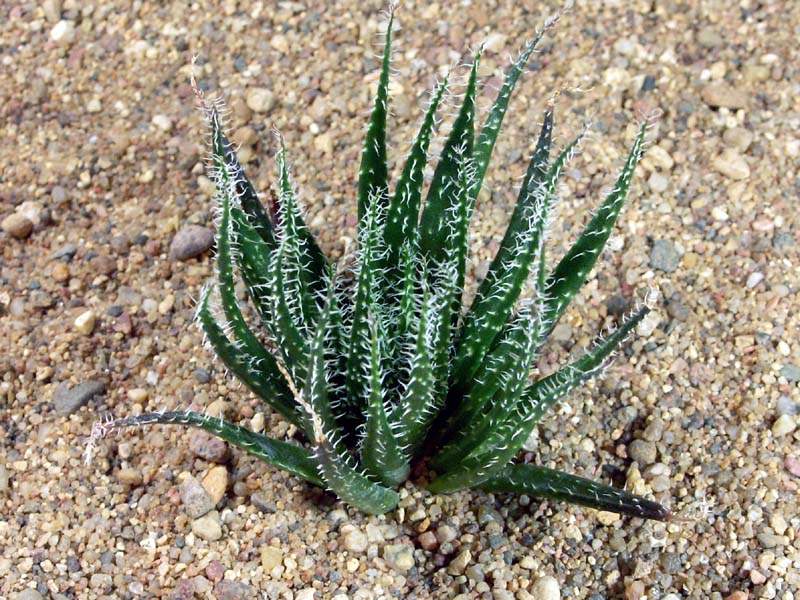
Aloe haworthioides, closeup of 3" body
Aloe haworthioides is named for the resemblance to its cousins in genus Haworthia. This resemblance is not coincidence; Aloe and Haworthia are genetically close and they hybridize easily.
Speaking of hybridizing, Aloe haworthioides is often used in aloe breeding. Its beauty and promiscuity are also drawbacks: many plants billed and sold as Aloe haworthioides are actually careless crosses from uncontrolled pollination. Sounds sexy... but be careful out there!

In the wild, it makes its home in the central mountains of Madagascar at an altitude of 1200-1800 m above sea level. Although a slow grower, it forms offsets and can reportedly be propagated by cuttings, i.e. removing these offsets.

Aloe haworthioides is stemless, perennial and herbaceous.

Here are some more technical details, cribbed from Peter Lapshin's site. (Someone—Saturn, Santa, or Satan—needs to bring me the new comprehensive book on the genus, Aloes: The Definitive Guide.)
Each plant body has up to 100 leaves, 3–4 cm long, approximately 6 mm wide, gray-green with white buds, arranged  in a dense rosette diameter of 4-5 cm, leaf margins with harmless white hairs or spines. Flower stems 20-30 cm tall, flowers fragrant, white or pale pink, 6-8 mm in length.

Aloe haworthioides from Peter Lapshin's site, http://www.lapshin.org/succulent/o-al-haw.htm
See Also

Aloe haworthioides at Peter Lapshin's site
Aloe haworthioides at Dave's Garden PlantFiles

Minggu, 27 November 2011

SUCCULENT SUNDAY: Haworthia tessellata, waxy windowed whorls


Haworthia tessellata 'Neat' shooting a bloom stalk. Can you see the windows in the leaf tops?
Haworthia tessellata is one of my favorite plants. At least, that's what I tell people. At least one friend has complained that I say that about so many plants that it can't possibly be true.

Haworthia limifolia, a close relative of H tessellata but lacking obvious windows in its leaves. It resembles opaque, molded plastic rather than translucent, carved wax.
The latin name tessellata comes from the tiled pattern in the leaf faces. Attractive, yes, but the bigger truth about these odd, waxy leaf faces is this: they evolved to be natural windows. Many Haworthia have adapted this way. Sunlight enters the plant body through these translucent windows and is converted into energy by many layers of chlorophyll-rich cells. This is especially useful in the arid climates where Haworthia tessellatamakes its living; the primary photosynthesis tissues are not exposed to the drying elements.

Haworthia tessellata 'Fang'
Haworthia tessellata 'Fang', a select clone named for the teeth and tubercles on the leaf undersides.
Leaves with window tops are described as fenestrate, from the Latin for window: fenestra.

Haworthia tessellata 'Super Tessellata'
Haworthia tessellata 'Super Tessellata', a beautiful, select clone
What's more, like many succulents, Haworthia tessellata can photosynthesize using Crassulacean Acid Metabolism (CAM). During CAM photosynthesis, the plant opens its stomata only during the cool of the night. It "inhales" in carbon dioxide and stores it in its thick, succulent tissues (while "exhaling" oxygen). During the heat of the day, the carbon dioxide stored deep in the plant can be used in photosynthesis because sunlight passes through the leaf windows, deep into the center of each leaf.

Haworthia tessellata in habitat. Photo by Jakub at http://haworthia-gasteria.blogspot.com/
See Also
Convergent Evolution in Succulent Desert Plants: Comparing Haworthia and Aloe (Africa) With Agave (America)